
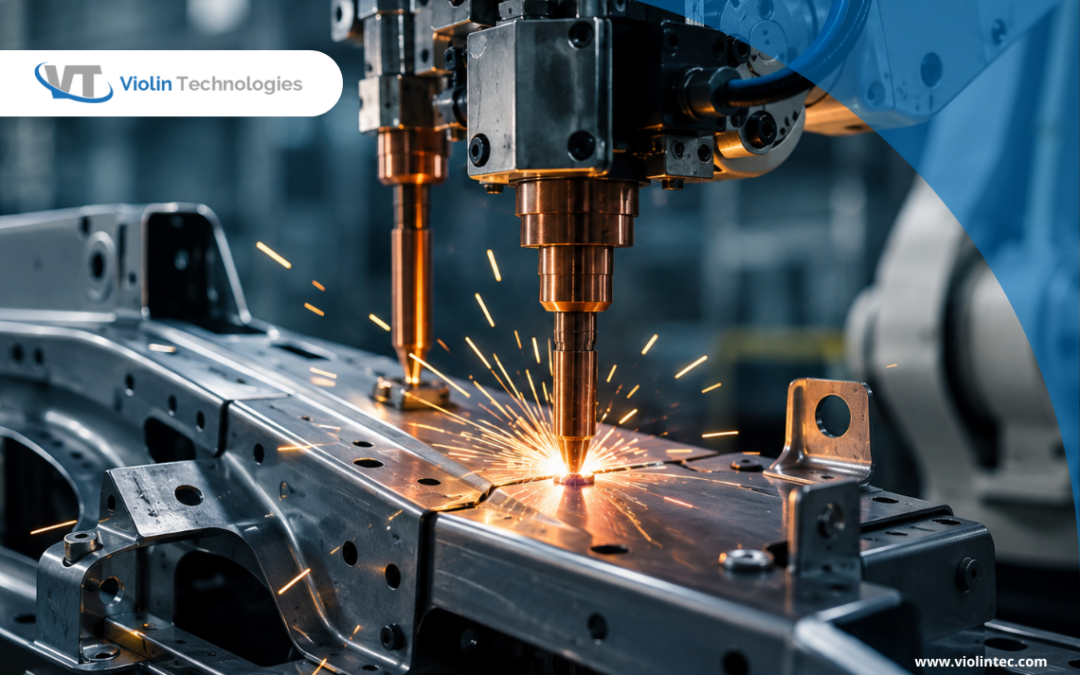
Spot welding is one of those processes that look simple on the surface but quietly make or break the quality of a sheet metal assembly. Get it right, and you save time, money, and a lot of post-weld rework. Get it wrong, and you end up with weak joints, warped parts, and unhappy customers. This guide walks through seven practical tips that set good spot welds apart from great ones, whether you’re working with a prototype or running at production volumes.
Before getting into the tips, let us understand what spot welding actually does. A concentrated electrical current arcs between two copper electrodes, pinching multiple layers of sheet metal together. The heat generated melts the material at the contact point, forming a circular weld nugget that fuses the sheets. The process is fast, clean, and highly repeatable, which is why it remains a go-to choice for custom sheet metal manufacturers across industries ranging from electronics enclosures to automotive brackets.
That said, spot welding is not a one-size-fits-all solution. Knowing when it works well and when to reach for seam or plug welding instead is the foundation of precision fabrication.
What Is the Difference Between Spot Welding and Seam Welding?
Spot welding creates discrete, coin-shaped weld points along an overlap joint. Seam welding, by contrast, uses rotating wheel electrodes to produce a continuous weld bead, making it ideal for watertight or airtight enclosures like tanks, pressure vessels, and marine components. Plug welding, also called rosette welding, is a third option that uses a TIG welder to fill holes drilled into one sheet, fusing it to the sheet below. Each method has its place, and experienced sheet metal and stamped parts suppliers will recommend the right one based on material, thickness, and application.
| Feature | Spot Welding | Seam Welding | Plug Welding |
|---|---|---|---|
| Joint type | Discrete points | Continuous bead | Filled holes |
| Watertight | No | Yes | No |
| Class A finish | Yes (no grinding) | Requires grinding | Smooth finish |
| Best thickness | 0.020″ – 0.090″ | Wide range | Thicker stock |
| Speed / cost | Fastest, lowest cost | Slower, higher cost | Moderate |
How Can You Improve Spot Weld Quality on Sheet Metal?
Design for a Class A Finish from the Start
One of the biggest advantages of spot welding is the ability to achieve a Class A finish without any post-weld grinding. This is possible when the design allows the material to overlap cleanly, hiding the weld from view.
Stay Within the Right Material Thickness Range
Spot welding reliably works on sheet metal between 0.020 and 0.090 inches thick. Materials thinner than 0.020 inches are at risk of burn-through during the welding cycle. Anything thicker than 0.090 inches will not produce a weld nugget strong enough to hold under load.
Do Not Assume Seam Welding Is Stronger
A persistent myth in fabrication circles is that seam welds are inherently stronger than spot welds. Within the correct thickness range, a properly placed spot weld provides equivalent structural integrity for most applications. Custom sheet metal manufacturers that have standardized their spot-welding process achieve consistent peel and shear strengths that meet structural sheet metal standards without resorting to seam welding for strength alone.
Know When Spot Welding Is Not Appropriate
Spot welds are not watertight. Each weld nugget leaves a discrete joint, and water or gas will pass between them. If your part needs to contain fluid or withstand pressure differentials, seam welding is the right call. Sheet metal and stamped parts suppliers with experience across industries will recognize these application requirements immediately.
Use Spot Welding to Reinforce Hat Channels
Hat channels are structural profiles shaped like a top hat in cross-section. They stiffen large flat panels significantly, reducing flex and vibration without adding excessive weight. For enclosures, electronic chassis, and equipment panels manufactured by the best contract manufacturers in India and abroad, hat channels with spot welds are a standard stiffening solution that is both cost-effective and structurally sound.
Plan Weld Placement Strategically for Function and Appearance
Where you put a spot weld matters as much as how you put it there. Welds placed too close to a bend radius can cause the material to crack during forming. Welds too close to the edge of an overlap flange risk pulling out under load. Electrode access is another constraint: the copper tips need clear physical access to both sides of the joint, which limits placement options on deep-drawn parts or narrow channels.
Leverage Spot Welding for High-Volume Cost Savings
Spot welding is the most time and cost-efficient assembly method for sheet metal at scale. The process is highly automatable, requires minimal fixturing compared to MIG or TIG welding, and cycles in a fraction of a second per weld.
What Are the Common Spot Welding Mistakes to Avoid in Sheet Metal Fabrication?
Most spot welding problems trace back to decisions made in the design phase rather than on the shop floor. Corner geometry is one of the most common trouble spots. Corners that will be welded need to be programmed correctly to allow proper electrode contact and to avoid stress concentration at the weld nugget. Fabricators who understand sheet metal DFM will reprogram corner geometry before welding rather than trying to force the electrode into a position that was never intended to be welded.
“The best spot weld is one that the designer planned for. The second-best is one that the fabricator caught during DFM review. The worst is one nobody noticed until it failed in the field
.”
Design Checklist Before Sending to Fabrication
- Material thickness: Confirm gauge is within 0.020″ to 0.090″ for spot welding
- Overlap flanges: Minimum flange width should allow electrode access on both sides
- Corner geometry: Flag corners requiring welding for fabricator review
- Watertight requirement: If yes, specify seam welding explicitly
- Surface finish: Confirm whether a Class A finish is required and if the overlap design supports it
- Weld callout: Specify welding method in the drawing notes, not just weld symbols
How Do You Choose the Right Sheet Metal Fabricator for Spot Welding Work?
Not every shop that offers spot welding is set up to do it well on precision parts. The right fabricator should have calibrated welding equipment with logged maintenance records, experienced operators who understand nugget formation and electrode conditioning, and a DFM review process that catches material and geometry issues before production begins.
Among the best contract manufacturers in India, many have invested heavily in resistance-welding equipment capable of handling tight tolerances for customers in the electronics, automotive, and industrial equipment sectors. The combination of competitive pricing, engineering capabilities, and ISO-certified quality management makes them a strong sourcing option for buyers seeking precision spot welding at scale. The key is verifying that any supplier you work with has hands-on experience with your specific material grades and thickness ranges, not just a machine that can technically perform the process.
Ready to Get Your Sheet Metal Parts Right?
Work with experienced Sheet metal and stamp part fabricators who will review your design, recommend the right welding method, and deliver consistent quality at any volume.