
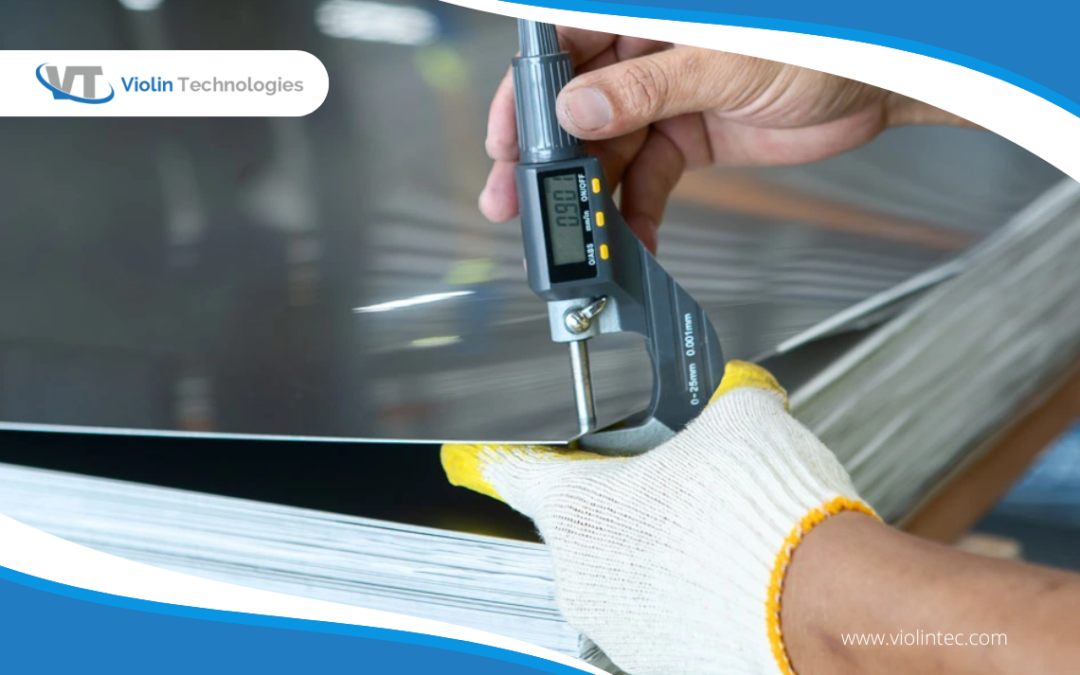
For industries such as automotive, aerospace, electronics, industrial equipment, and enclosures, proper thickness selection is critical for achieving the right balance between performance and cost efficiency. This is why experienced Custom Sheet Metal Manufacturers pay close attention to material thickness during product design and production planning.
In this blog, we will explain how sheet metal gauge thickness affects fabrication, the factors that influence thickness selection, and how manufacturers optimize strength, weight, and cost for different applications.
What we cover in this blog?
- What Is Sheet Metal Thickness?
- Why Is Sheet Metal Thickness Important?
- How do you choose the right sheet metal thickness?
- What happens if sheet metal is too thin?
- What happens if sheet metal is too thick?
- Factors That Influence Sheet Metal Thickness Selection
- Sheet Metal Gauges Comparison Across Common Ranges
- How Manufacturers Optimize Thickness Selection
- Common Thickness Selection Mistakes
- Importance of Working with Experienced Manufacturers
What Is Sheet Metal Thickness?
Sheet metal thickness refers to the thickness of metal sheets used in fabrication processes such as laser cutting, punching, bending, welding, and stamping. Thickness is typically measured in millimeters or gauge numbers, depending on the region and industry standards.
Common sheet metal materials include:
- Steel
- Stainless steel
- Aluminum
- Copper
- Brass
Different applications require different thickness ranges based on structural and functional requirements.
Why Is Sheet Metal Thickness Important?
Strength and Durability: Thicker materials generally provide better structural strength and load-bearing capability. They resist bending, vibration, and mechanical stress more effectively.
Weight: Increasing thickness also increases weight. In industries such as aerospace and automotive, excess weight reduces fuel efficiency and performance.
Manufacturing Cost: Thicker sheets require more raw material and often increase machining, forming, and transportation costs.
Formability: Thin materials are easier to bend and shape, while thicker materials may require higher forming force and specialized tooling.
This is why Sheet Metal and stamped parts suppliers carefully evaluate thickness requirements before starting production.
How do you choose the right sheet metal thickness?
Selecting the right thickness depends on:
- Load and structural requirements
- Product application
- Environmental exposure
- Manufacturing process
- Cost limitations
Engineers often balance mechanical performance with production efficiency to select the most practical material thickness.
What happens if sheet metal is too thin?
Using sheet metal that is too thin can create several problems:
- Reduced strength
- Excessive vibration
- Warping during welding or forming
- Lower product life
Thin materials may also fail under repeated stress or harsh environmental conditions.
What happens if sheet metal is too thick?
Using material that is thicker than necessary increases:
- Product weight
- Material costs
- Machining and forming time
- Tool wear
Overdesigning a component can significantly increase manufacturing expenses without adding real performance benefits.
Factors That Influence Sheet Metal Thickness Selection
1. Product Function and Load Requirements
The first factor is how the component will be used. Structural parts that carry heavy loads require thicker material than cosmetic covers or lightweight panels.
For example:
- Electrical enclosures may use thinner sheets.
- Machine frames require thicker structural materials.
- Automotive brackets need balanced metal gauge thickness for strength and weight reduction.
2. Material Type
Different metals exhibit different strengths at the same thickness.
For example:
- Stainless steel offers higher strength than aluminum.
- Aluminum provides lightweight performance.
- Mild steel is cost-effective and widely used.
Material properties determine the thickness required to achieve the desired strength.
3. Manufacturing Process
The fabrication process also impacts thickness selection.
Laser Cutting: Very thick materials require higher laser power and slower cutting speeds.
Stamping: Thicker sheets require stronger dies and presses.
Welding: Thicker materials may need additional heat input and welding preparation.
Bending: Forming thick materials requires higher tonnage and larger tooling.
This is why Sheet Metal and stamped parts suppliers often recommend thickness ranges that suit both design and manufacturing requirements.
4. Environmental Conditions
Environmental exposure affects thickness selection significantly. Products exposed to moisture, corrosion, heat, and mechanical impact may require thicker or more durable materials to maintain long-term performance.
Outdoor industrial equipment often uses thicker, more heavily coated materials than indoor applications.
5. Weight Reduction Requirements
Modern industries focus heavily on lightweight design.
In sectors such as Aerospace, Automotive, and Consumer electronics, reducing material thickness helps improve energy efficiency and portability. However, reducing thickness must not compromise structural integrity.

Sheet Metal Gauges Comparison Across Common Ranges
Here’s a practical reference for how common thickness ranges compare across strength, weight, fabrication cost, and typical applications.
| Range | Approx. Thickness | Strength | Fab cost | Weight | Uses |
|---|---|---|---|---|---|
| Thick gauge | 0.120″–0.250″+
(11 ga–¼”+) |
High | High | High | Structural bases, load-bearing parts, heavy-duty components |
| Medium gauge | 0.060″–0.120″
(16–11 ga steel) |
Moderate–High | Medium | Medium | Frames, brackets, equipment housings, formed parts |
| Thin Gauge | 0.020″–0.060″
(26–16 ga steel) |
Low–Moderate | Low | Very Low | Enclosures, covers, light panels, brackets |
The goal is not always to choose the thickest material but to select the thickness that delivers the required performance at the lowest practical cost.
How Manufacturers Optimize Thickness Selection
Design Analysis: Engineers use CAD software and simulations to evaluate stress points and material performance before manufacturing begins.
Prototype Testing: Physical prototypes help validate thickness selection under real operating conditions.
Finite Element Analysis (FEA): FEA tools predict how materials behave under load, vibration, and thermal conditions.
Process Optimization: Manufacturers adjust tooling, bend angles, and forming methods to improve performance while minimizing material usage.
Common Thickness Selection Mistakes
Ignoring Manufacturing Limits: Designs that are difficult to bend or stamp increase production complexity.
Overdesigning Components: Using unnecessarily thick material raises costs without improving functionality.
Not Considering Tolerances: Thickness variation affects fitment and assembly quality.
Choosing Based Only on Cost: Low-cost thin materials may fail prematurely, increasing long-term replacement costs.
Importance of Working with Experienced Manufacturers
Thickness optimization requires both engineering knowledge and manufacturing experience.
Reliable Custom Sheet Metal Manufacturers help customers:
- Select suitable materials.
- Optimize thickness for production.
- Reduce fabrication challenges.
- Improve product reliability.
Similarly, experienced Best Contract Manufacturers in India support customers with cost-effective manufacturing solutions while maintaining quality standards.
Conclusion: The Right Thickness Is Always a System Decision
Thickness doesn’t exist in isolation. It interacts with material type, part geometry, fabrication process, finish requirements, and real-world load conditions. Before you finalize your gauge, ask yourself:
- What are the actual functional requirements and load conditions?
- Can geometry, flanges, ribs, and bends contribute strength before adding material?
- Is my specified material readily available in this thickness, or will source spike costs?
- Have I looped in my fabricator before locking in the design?
The goal isn’t the thickest gauge that works; it’s the right gauge for this part, this material, this application. That’s where strength, weight, and cost truly align.