
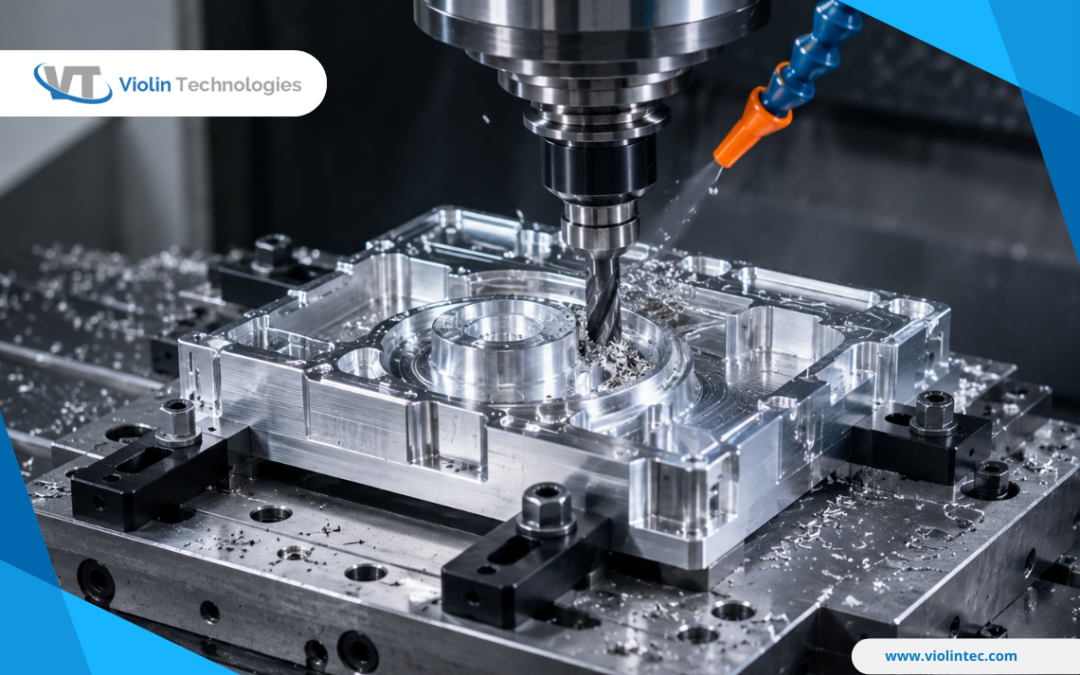
Aluminum is one of the easiest metals to machine, yet it can quickly become one of the most frustrating materials when parts start bending, warping, or losing dimensional accuracy halfway through production.
A component that looked perfect in the CAD model may come off the machine with slight distortion, making it unusable for assembly. Even a tiny deformation can lead to rejected parts, missed deadlines, and higher production costs. For manufacturers handling tight tolerances, these issues aren’t just inconvenient—they directly affect customer satisfaction and profitability.
The good news is that most deformation problems are preventable. With the right machining strategy, tooling, workholding, and process planning, manufacturers can significantly reduce stress-related distortion while maintaining excellent surface quality.
Whether you’re working with prototypes or high-volume production, these proven practices will help you achieve more consistent results in CNC milling aluminum.
Why Does Aluminum Deform During CNC Milling?
Aluminum is lightweight, ductile, and has relatively low stiffness compared to steel. Those same properties that make it so machinable also make it more likely to move once material starts coming off the block.
The most common causes of deformation include:
- Internal residual stresses already present within the raw material
- Excessive cutting forces during roughing
- Heat generated during machining
- Poor or uneven workholding
- Removing too much material from one side at once
- Improper tool selection or machining parameters
Understanding which of these factors is at play is the first step toward producing dimensionally stable, high-quality parts.
Best Practices to Prevent Deformation in CNC Milling Aluminum
1
Choose the Right Aluminum Grade
Not every aluminum alloy behaves the same way under a cutter. 6061-T6 offers a strong balance between machinability and strength, which is why it shows up so often in precision components. Softer grades, on the other hand, tend to deform more easily under cutting forces. Selecting the right material for the application before production begins removes one of the biggest variables from the process. A reliable CNC precision machining partner will recommend the right alloy based on your design, strength needs, and production volume.
2
Relieve Internal Stress Before Machining
Most aluminum blocks carry residual stress left over from rolling, forging, or extrusion. When a large amount of material is removed, the hidden stress redistributes, and the part bends or twists in response. Common stress-relieving methods include heat treatment, natural aging, artificial aging, and simply letting a roughed part rest before the finishing pass. Giving the material time to stabilize almost always improves the final dimensional accuracy.
3Use Balanced Material Removal
Machine both sides progressively instead of hogging out one face first. Alternate operations between surfaces and maintain even wall thickness even to avoid uneven stress distribution.
4Optimize Cutting Parameters
Dial in feed rate, spindle speed, depth of cut, and step-over rather than pushing for the fastest cycle time. Lighter finishing passes protect tight tolerances.
5Select Sharp, High-Quality Tools
Use polished carbide end mills built for non-ferrous metals and swap them before performance drops. Dull tools raise cutting pressure and heat fast.
6Improve Workholding, Don’t Over-Clamp
Soft jaws, vacuum fixtures, and custom support under thin sections hold the part securely without introducing the stress that causes spring back later.
7
Use Proper Toolpath Strategies
Modern CAM software offers adaptive toolpaths that maintain consistent tool engagement, rather than relying on conventional pocketing. The payoff is lower cutting forces, reduced vibration, better heat management, longer tool life, and more predictable dimensional stability, which matters most on complex aerospace and automotive components.
8
Control Heat During Machining
Aluminum dissipates heat quickly, but sustained cutting temperatures can still throw off accuracy. Using the right coolant, maintaining continuous chip evacuation, optimizing spindle speeds, and avoiding prolonged tool engagement all help keep machining temperatures in check and dimensions consistent.
9
Leave Stock for Final Finishing
Trying to hit the final dimension in a single heavy pass puts more stress on the part than it can withstand. A safer sequence is to rough the part, leave a small finishing allowance, let it stabilize, and then complete the final finishing pass. This one change alone prevents a large share of last-minute distortion.
10
Take Advantage of 5-Axis Machining
Complex components often require multiple setups on a conventional 3-axis machine, and each new setup introduces new clamping forces and alignment variations. With 5-axis CNC machining services, multiple faces can be cut in a single setup, which means less handling, greater accuracy, lower risk of deformation, and faster overall cycles, especially valuable for intricate aerospace, medical, and electronics parts.
11
Verify Parts Throughout the Process
Inspection should not wait until the part is finished. In-process measurements catch movement early, before it becomes a scrapped part. Regular dimensional checks help identify distortion sooner, adjust parameters mid-run, and keep scrap rates and tolerances where they need to be. An ISO-9001 certified CNC machine shop typically follows documented inspection procedures that maintain consistency across every batch, not just the first article.
Preventing deformation is not about one perfect setup. It is about controlling stress at every stage, from raw stock to final inspection.
12
Work With the Right Manufacturing Partner
Preventing deformation is not only about equipment. It is about experience. A knowledgeable machining team understands how different aluminum grades behave, how machining parameters influence internal stress, and how to build an efficient production sequence around that knowledge.
The Best Quality Contract Manufacturing Partners in USA invest in advanced equipment, skilled machinists, process validation, and quality systems that consistently deliver accurate parts, run after run. Whether the project is a handful of prototypes or a full production order, choosing the right Contract CNC manufacturing partner reduces production risk while improving overall efficiency.
For teams working under tight schedules, Fast turnaround CNC machining should never mean cutting corners on stress control. And for new designs, Rapid prototype CNC services give engineers an early chance to catch deformation issues before a design ever reaches full-scale production.
Final Thoughts
Aluminum remains one of the most versatile materials in precision manufacturing, but consistent results take more than just picking the right machine. Material selection, machining strategy, cutting tools, workholding, heat control, and inspection all contribute to keeping a part true to the CAD model.
When precision, repeatability, and production efficiency matter, working with an experienced CNC precision machining partner makes the difference. A trusted provider offering CNC milling and turning services, advanced 5-axis CNC machining services, and dependable Contract CNC manufacturing can turn a demanding aluminum design into a reliable, high-quality part delivered on time and to specification.
Get Precision Aluminum Parts Without the Guesswork
From prototype to full production, our stress-controlled machining process keeps tight-tolerance aluminum parts flat, stable, and ready for assembly.