
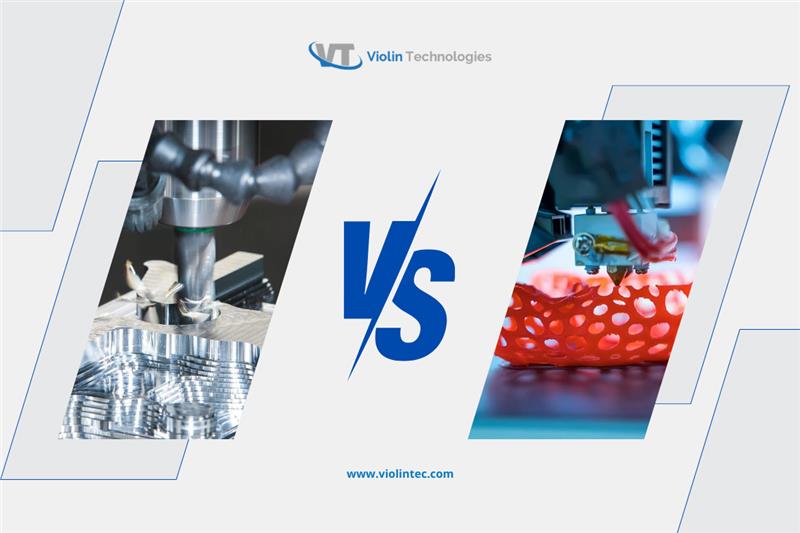
This blog explains the key differences between CNC machining and 3D printing in simple, technical terms. We will look at how each process works, where they perform best, and how to decide which one suits your project.
What we cover in this blog?
What Is CNC Machining?
CNC machining is a subtractive manufacturing process. A solid block of material, called a billet, is cut into the final shape using computer-controlled machines. These machines include mills, lathes, and multi-axis machining centers.
CNC machining removes material using cutting tools that follow precise tool paths. The process is known for accuracy, repeatability, and tight tolerances. Many industries rely on production CNC machining services for parts that must meet strict mechanical and dimensional requirements.
CNC machining is used to work with metals such as aluminum, steel, titanium, and brass, as well as engineering plastics.
What Is 3D Printing?
3D printing is an additive manufacturing process. Instead of removing material, it builds parts layer by layer from digital models. Common methods include FDM, SLA, and SLS.
Material options depend on the printing technology and include plastics, resins, and some metal powders. 3D printing is widely used for prototypes, design validation, and low-volume production.
The main advantage of 3D printing is design freedom. Complex internal geometries that are difficult or impossible to machine can often be printed.
Key Difference Between CNC Machining and 3D Printing
Manufacturing Method
The most basic difference lies in how parts are made.
CNC machining removes material from a solid block. This results in strong, dense parts with consistent material properties.
3D printing adds material layer by layer. While this allows for complex shapes, the layered structure can lead to weaker mechanical properties in certain directions.
This difference directly affects strength, surface finish, and part reliability.
Accuracy and Tolerances
CNC machining is known for high precision. Tolerances of ±0.01 mm or better are achievable with the right setup. This makes CNC machining the preferred choice for components that must fit or function precisely.
3D printing generally has lower accuracy. Dimensional variation can occur due to layer thickness, shrinkage, or thermal effects. Post-processing is often required to improve fit.
If your application requires tight tolerances, working with a CNC precision machining partner is usually the better option.
Material Strength and Performance
CNC-machined parts retain the original material properties of the billet. This makes them suitable for load-bearing, high-temperature, or safety-critical applications.
3D-printed parts may exhibit anisotropic strength, meaning that strength varies with print direction. Some advanced metal printing processes improve this, but they remain expensive and complex.
For functional end-use parts, CNC manufacturing aluminum parts are often chosen for consistent performance.
Surface Finish
CNC machining produces smooth and consistent surface finishes. Additional finishing operations such as polishing, anodizing, or coating can further improve appearance and performance.
3D-printed parts typically have visible layer lines. Post-processing, like sanding or coating, is often required to achieve a smooth surface.
If appearance or sealing surfaces are important, CNC machining offers better results.
Design Complexity
3D printing excels at complex designs. Internal channels, lattice structures, and organic shapes are easier to produce with additive manufacturing.
CNC machining is limited by tool access. Some complex features require multiple setups or specialized tooling.
For early-stage design exploration, 3D printing is often faster and more flexible.

Production Volume and Cost
For low-volume or prototype projects, 3D printing can be cost-effective because it requires minimal setup.
As volume increases, CNC machining becomes more economical. Tool paths can be optimized, and cycle times reduced, making CNC machining services suitable for medium to high volumes.
Lead Time
3D printing offers fast turnaround for prototypes. Parts can often be printed within hours or days.
CNC machining may require more setup time, especially for complex parts. However, once the process is optimized, repeat production is faster and more consistent.
For long-term programs, CNC machining provides predictable lead times.
Quality and Repeatability
CNC machining delivers high repeatability. Once a program is validated, parts can be produced with consistent quality across batches.
3D printing may show variation between builds due to machine calibration, material behavior, or environmental conditions.
Industries that require strict quality control often rely on a CNC precision machining partner for repeatable results.
Typical Applications
CNC Machining Applications
- Aerospace and automotive components
- Medical device parts
- Industrial equipment components
- High-precision mechanical parts
3D Printing Applications
- Rapid prototyping
- Concept models
- Low-load functional parts
- Design validation
Each process has a clear role depending on the application.
Choosing the Right Process
The choice between CNC machining and 3D printing depends on several factors:
- Required tolerance and accuracy
- Material and strength requirements
- Production volume
- Surface finish needs
- Budget and timeline
Many companies use both processes. 3D printing is used during development, while CNC machining is used for final production through contract CNC manufacturing partners.
Conclusion
CNC machining and 3D printing are not competitors; they are complementary technologies. CNC machining offers precision, strength, and repeatability, making it ideal for production parts. 3D printing provides flexibility and speed for prototyping and complex designs.
Understanding these differences helps you make informed decisions and avoid costly mistakes. Whether you need fast prototypes or reliable production parts, choosing the right manufacturing process and partner is key to success.
Working with an experienced CNC precision machining partner ensures your parts meet performance, quality, and delivery expectations—today and as your production scales.