
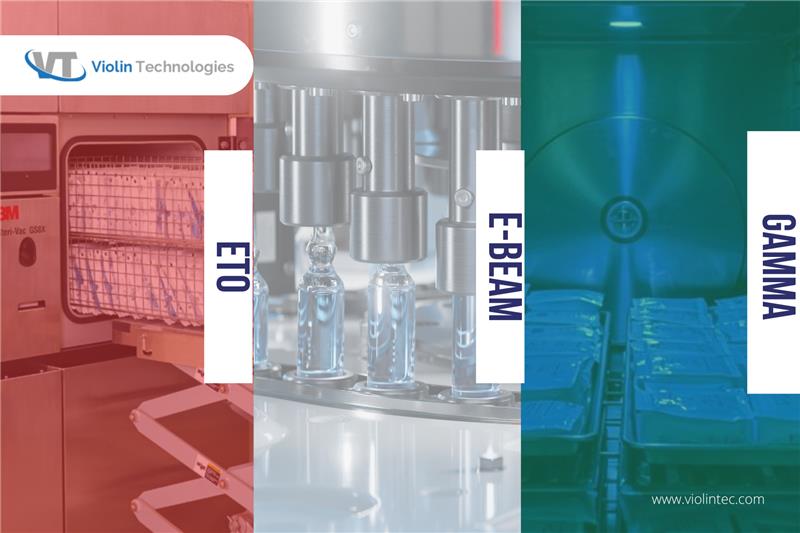
For companies working with an ISO 13485 Certified Contract Manufacturing Company, understanding sterilization methods is essential for making informed decisions. Whether you are producing implants, surgical tools, or electronic devices, your choice between Ethylene Oxide, Electron Beam, and Gamma sterilization will shape your product’s success.
This guide breaks down these three major sterilization methods, their differences, and how to select the right one.
What we cover in this blog?
- Why Sterilization Matters in Medical Device Manufacturing
- Overview of the Three Main Sterilization Methods
- Ethylene Oxide Sterilization ETO
- Electron Beam Sterilization (E-Beam)
- Gamma Radiation Sterilization
- ETO vs E Beam vs Gamma: Key Differences
- How to Choose the Right Sterilization Method
- The Role of Manufacturing Partners
Why Sterilization Matters in Medical Device Manufacturing
Medical devices come into direct or indirect contact with the human body. Any contamination can lead to serious infections or complications. Regulatory standards require a Sterility Assurance Level of 10⁻⁶, meaning there is only a one in a million chance of a non-sterile unit.
Achieving this level of sterility requires careful coordination between design, material selection, and manufacturing processes, such as medical device CNC machining. The sterilization method must be compatible with the device’s material, packaging, and intended use.
Overview of the Three Main Sterilization Methods
The three most widely used sterilization methods in the medical device industry are:
- Ethylene Oxide Sterilization (ETO)
- Electron Beam Sterilization (E- Beam)
- Gamma Radiation Sterilization
Each method uses a different approach to eliminate microorganisms and has unique advantages and limitations.
Ethylene Oxide Sterilization ETO
How It Works
ETO sterilization uses ethylene oxide gas to penetrate packaging and destroy microorganisms by disrupting their DNA. The process includes preconditioning, gas exposure, and aeration to remove residual gas.
Key Advantages
ETO is known for its excellent penetration capability. It can sterilize complex devices with intricate geometries, including long tubes and multi-layer assemblies. It is also compatible with most materials, including plastics and electronics.
Because of this, ETO remains the preferred method for many sensitive and complex devices.
Limitations
The biggest drawback of ETO is the time required. The process can take several hours or even days due to the required aeration phase to remove toxic residues.
It also involves handling hazardous gases, which requires strict environmental and safety controls.
Best Use Cases
- Complex devices with internal channels
- Heat-sensitive materials
- Pre-packaged sterile products
For companies working with Best Quality Contract Manufacturing Partners in the USA, ETO is often the default choice for sophisticated medical assemblies.
Electron Beam Sterilization (E-Beam)
How It Works
E-beam sterilization uses high-energy electrons generated by an electron beam to destroy microorganisms. The process is fast and takes place in a controlled environment, without the need for chemicals.
Key Advantages
One of the biggest advantages of E-Beam is speed. Sterilization can be completed in seconds, allowing faster product release and reduced inventory delays.
It does not use toxic gases or radioactive materials, which simplifies handling and eliminates concerns about residue.
It also causes less material degradation than slower radiation methods, due to a shorter exposure time.
Limitations
E-beam have lower penetration compared to other methods. This makes it less suitable for dense products or large packaging configurations.
It is typically best for smaller or less dense items.
Best Use Cases
- Single-use disposable devices
- Thin or low-density products
- High volume production requiring fast turnaround
For manufacturers using Medical device CNC machining for smaller precision components, E-Beam offers an efficient sterilization option.
Gamma Radiation Sterilization
How It Works
Gamma sterilization uses radiation from cobalt-60 to penetrate products and destroy microorganisms. It is one of the most established sterilization methods in the industry.
Key Advantages
Gamma radiation offers deep penetration, making it ideal for bulk products and densely packed materials.
It is highly reliable and widely accepted by regulatory authorities, with decades of validation and usage.
Limitations
The process is slower compared to E-Beam and may cause material degradation, especially in certain plastics.
It also depends on radioactive sources, which involve supply, safety, and disposal challenges.
Best Use Cases
- High volume manufacturing
- Dense or bulk packaged devices
- Products requiring deep penetration sterilization

ETO vs E Beam vs Gamma: Key Differences
Penetration
ETO and Gamma provide deep penetration, making them suitable for complex or dense products. E-beam has limited penetration and works best for smaller items.
Speed
E-beam is the fastest method, completing sterilization in seconds. Gamma takes hours, while ETO requires the longest cycle due to aeration.
Material Compatibility
ETO is the most versatile and works with sensitive materials. E-beam is gentle on many polymers, while Gamma may degrade certain materials over time.
Environmental and Safety Factors
E-beam is considered cleaner since it uses electricity and leave no residue. ETO involves toxic gas, and Gamma relies on radioactive sources.
How to Choose the Right Sterilization Method
Selecting the right method depends on several factors:
Device Complexity
Complex designs with internal pathways often require ETO for proper penetration.
Material Sensitivity
If your device includes heat-sensitive plastics or electronics, ETO or E-Beam may be better choices.
Production Volume
High-volume production may favor Gamma or E-Beam due to their scalability and efficiency.
Time to Market
If speed is critical, E Beam provides the fastest turnaround.
Regulatory Requirements
Working with an ISO 13485 Certified company ensures that sterilization processes are validated and compliant with global standards.
The Role of Manufacturing Partners
Sterilization does not exist in isolation. It is closely linked to how a device is designed and manufactured.
An ISO 13485 Certified Contract Manufacturing Company ensures that sterilization considerations are integrated from the early design stage. This includes selecting compatible materials, designing for sterilization, and validating processes.
For example, precision parts produced through medical device CNC machining must maintain dimensional stability even after sterilization. Poor material selection or incorrect sterilization methods can lead to warping, discoloration, or reduced performance.
This is why many OEMs rely on Best Quality Contract Manufacturing Partners in the USA, who offer end-to-end expertise from machining to sterilization.
Final Thoughts
ETO, E-Beam, and Gamma sterilization each play a vital role in the medical device industry. There is no one-size-fits-all solution. The right choice depends on your product design, materials, and manufacturing goals.
ETO remains the gold standard for complex and sensitive devices. E-Beam offers speed and efficiency for modern production needs. Gamma continues to provide deep penetration and proven reliability for bulk sterilization.
By understanding these methods and working with an experienced ISO 13485 Certified company, manufacturers can ensure their products meet the highest standards of safety and performance.
In a highly regulated industry where patient safety is the top priority, the right sterilization strategy is not just a technical decision. It is a business-critical one.