
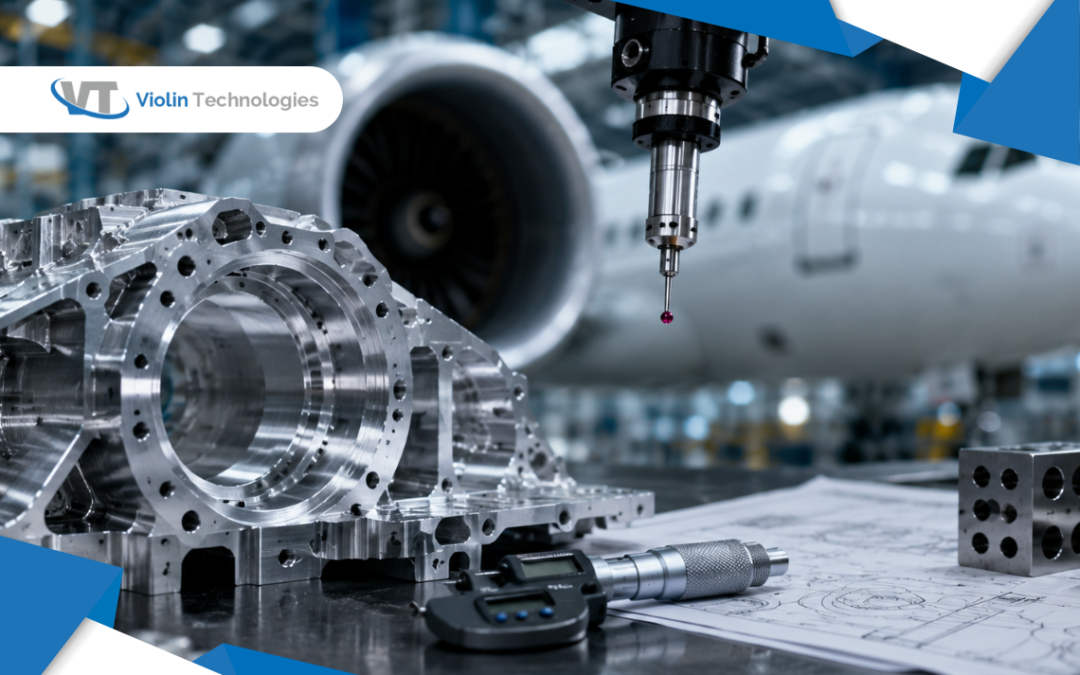
A gap of 0.002 inches. That is thinner than a human hair, and in aerospace, it is the difference between a component that holds and one that fails at 35,000 feet. If you have ever wondered why aerospace parts cost what they do, or why lead times stretch the way they do, the answer almost always comes back to one thing: tolerances.
Aerospace engineering does not tolerate guesswork. Every bolt hole, every turbine blade profile, every actuator bore is held to dimensional specifications so precise that conventional manufacturing methods simply cannot get there. The moment a buyer starts searching for an aerospace CNC machining company, they quickly realize that not every machine shop is equipped to handle this level of accountability. And that distinction matters more than most people outside the industry ever appreciate.
This post breaks down what tight tolerances mean, why they are non-negotiable in aerospace, and what to look for when choosing a manufacturing partner who can consistently hit the mark.
0.001″
Typical aerospace tolerance
25 µm
Equivalent in microns
10x
Tighter than general manufacturing
100%
Inspection required on critical parts
What Are Tight Tolerances in Aerospace CNC Machining?
In general manufacturing, a tolerance of ±0.010 inches is considered perfectly acceptable for most applications. In aerospace, that number shrinks dramatically. Parts like turbine blades, landing gear pins, and hydraulic actuators are routinely held to ±0.001 inches or tighter. Some components push down to sub-micron precision.
Tight tolerances govern the dimensional accuracy of a finished part compared to its engineering drawing. They control how much a measurement can deviate from the intended value without compromising function. In aerospace, those limits exist because the physics of flight demand it. Pressure differentials, thermal cycling, vibration loads, and high-speed rotation all expose the smallest dimensional inconsistencies in ways that ground-based equipment never would.
Why Do Tight Tolerances Improve Aerospace Safety?
Structural integrity under load: Precise fit between mating components eliminates micro-gaps that become stress concentration points. Under repeated load cycles, those gaps grow into cracks. Tight tolerances prevent that failure mode from the start.
Reliable assembly and fit: When every part in a sub-assembly is dimensionally consistent, assembly is predictable. There is no shimming, no filing, no improvised fix on the production floor. That repeatability is critical when the same assembly must perform identically across hundreds of aircraft.
Performance under extreme conditions: Engines operate at temperatures that would warp lesser components. Hydraulic systems pressurize to thousands of PSI. Tight tolerances ensure that parts maintain their designed function across the full operational envelope, not just at room temperature on the ground.
Reduced maintenance burden: Parts that fit right wear more evenly and last longer. Airlines and defense operators track component life closely, and a part machined to spec consistently outlasts one that scraped through inspection on the borderline.
Regulatory compliance: Aviation regulators worldwide, including the FAA and EASA, require documented traceability and dimensional verification for flight-critical parts. A shop that cannot reliably hit tolerances cannot produce the paperwork either, which disqualifies them entirely from aerospace supply chains.
In aerospace, the question is never whether tolerances are worth the cost. The question is whether your manufacturing partner can actually achieve them, every single time, at production volume.
Precision Manufacturing Principle
How Does a CNC Machine Shop Achieve Aerospace-Grade Precision?
Achieving sub-thousandth-inch tolerances is not just about having the right equipment, though that matters enormously. It requires a culture of precision that runs from the front office through the shop floor and into the quality lab. Here is what separates a capable contract CNC manufacturing facility from one that is simply running standard work:
Multi-axis CNC machining centers: Five-axis and beyond machines can hold geometry in a single setup, eliminating cumulative errors that occur when parts are repositioned multiple times. Each repositioning introduces its own tolerance stack-up, and aerospace does not have room for that.
Electrical Discharge Machining (EDM): For geometries that cannot be reached with a cutting tool, EDM removes material through controlled electrical discharge. It produces features with excellent surface finish and dimensional accuracy, especially in hardened materials that resist conventional tooling.
Coordinate Measuring Machines (CMM): CMMs are the backbone of aerospace inspection. They probe part surfaces with micron-level accuracy and generate full dimensional reports that become part of the certification paperwork. Without CMM capability, a shop simply cannot prove its parts meet specification.
Disciplined tool management: Worn tools drift dimensionally. Aerospace shops use tool life management systems that pull and replace tooling before wear causes specification violations, not after. That is a fundamental difference from production environments focused only on throughput.
Which Aerospace Components Require the Tightest Tolerances?
Not every aerospace part requires the same level of precision, but the components that do require extreme accuracy are exactly the ones where failure has the worst consequences.
Turbine Engine Blades
Airfoil profiles and tip clearances must be exact. Even small deviations alter aerodynamic efficiency and can trigger compressor stall at altitude.
Landing Gear Assemblies
Hydraulic cylinders, actuator rods, and pivot pins must fit precisely to prevent binding, seal failure, and structural overload during landing.
Flight Control Actuators
Pilots depend on predictable, linear control response. Loose tolerances in actuator components translate directly into sluggish or unpredictable flight behavior.
Fuel System Injectors
Precise internal geometry controls atomization and flow rate. Deviations affect combustion efficiency, emissions output, and engine power delivery.
Avionics Housings
Enclosures for flight-critical electronics must seal reliably against moisture and pressure changes. Dimensional accuracy is essential for gasket performance.
Fasteners and Bolted Joints
Thread and shank tolerances on aerospace fasteners prevent loosening due to vibration and ensure proper clamp load throughout the service life of the structure.
How Do You Choose the Right Aerospace CNC Machining Company?
This is where procurement decisions get consequential. Not every shop that calls itself a precision machinist has the equipment, the process discipline, or the quality infrastructure to reliably produce aerospace-grade components. Here is a practical framework for evaluating a prospective aerospace CNC machining company:
Review their certification stack: ISO 9001 is essential. AS9100 certification is the aerospace-specific quality standard built on top of it. A shop with AS9100 has been audited specifically for aerospace work, which is a meaningfully higher bar.
Assess their inspection capability: Ask what measurement equipment they have, how often it is calibrated, and who performs the calibration. A shop relying on handheld micrometers for aerospace inspection is not set up for the work.
Understand their material experience: Aerospace materials behave differently from structural steel or aluminum alloys used in general manufacturing. A shop with proven experience in titanium, Inconel, and aerospace-grade aluminum will have the tooling strategies and feed-rate knowledge that protects tolerances through production runs.
Ask for first-article inspection reports: Any credible contract CNC manufacturing partner should be able to produce full dimensional reports for the first part off a new program. If they cannot, or if the concept is unfamiliar to them, that is a significant warning sign.
Evaluate their capacity for your production volume: A shop that can meet tolerances on a single prototype may not be able to maintain those tolerances across a production run of several hundred units. Ask about their statistical process control practices and how they monitor dimensional drift across a run.
Does Precision Machining Cost More, and Is It Worth It?
Yes, tight tolerance machining costs more. Slower feed rates, premium tooling, more frequent inspection steps, environmental controls, and the time required to produce and verify first articles all increase per-part cost. There is no way around that reality, and any shop quoting aerospace tolerances at commodity prices should raise an immediate flag.
The more useful question is whether the cost is worth it, and in aerospace, the answer is always yes. The alternative is a part that fails inspection before flight, or worse, one that passes inspection and fails in service. The cost of a returned shipment, a grounded aircraft, or a safety incident dwarfs the premium of precision machining many times over.
Working with a qualified contract electronics manufacturing partner or a precision CNC machining supplier who understands aerospace requirements is not a cost decision. It is a risk management decision. The right partner brings process stability, documented quality, and institutional knowledge to anticipate problems before they appear in inspection results.
Ready to Work With a Partner Who Gets It Right?
When your program demands sub-thousandth tolerances and zero room for error, experience and process discipline matter more than price. Talk to a qualified aerospace machining partner today.