
Choosing the right approach is not just a technical decision. It affects cost, strength, manufacturability, and long-term performance. Understanding these differences can help you make smarter design and sourcing decisions. This guide explains the key differences between single formed parts and welded assemblies and helps you decide which approach suits your project best.
What we cover in this blog?
- What is a Single Formed Part?
- What is a Welded Assembly?
- What are the advantages of a single formed part?
- What are the advantages of welded assemblies?
- Which is stronger: formed parts or welded assemblies?
- When should you choose a single formed part?
- When should you choose a single formed part?
- What are the common mistakes to avoid?
- How to choose the right approach for your project?
What is a Single Formed Part?
A single formed part is created by cutting a flat sheet and bending it into the required shape using processes like press brake forming. The entire component is made from one continuous piece of material.
This approach eliminates joints and welds, resulting in a clean and structurally consistent part.
What is a Welded Assembly?
A welded assembly is made by forming multiple smaller parts and joining them using welding. These assemblies combine individual components into a single functional unit.
Welding creates strong, permanent joints and allows manufacturers to build complex geometries that are difficult or impossible to form from a single sheet.
What are the advantages of a single formed part?
1. Higher Structural Strength
Single formed parts are inherently strong because they do not have weld seams. Welded joints create heat-affected zones that can weaken material properties, while formed parts maintain a continuous grain structure.
This makes them ideal for applications involving vibration or repeated stress.
2. Lower Manufacturing Cost
Fewer operations mean lower cost. A formed part typically involves cutting, bending, and finishing. There is no need for welding, grinding, or additional inspection steps.
In high-volume production, this efficiency significantly reduces the cost per unit.
3. Better Surface Finish
Formed parts offer a cleaner appearance, with no weld marks or discoloration. This is especially important for visible components or products requiring premium aesthetics.
4. Faster Production Time
With fewer steps involved, formed parts can be produced quickly. Once tooling is set, production becomes highly repeatable.
Working with reliable Sheet Metal and Stamped parts suppliers ensures consistent quality, whether you choose forming or welding.
What are the advantages of welded assemblies?
1. Greater Design Flexibility
Some geometries simply cannot be formed from a single sheet. Deep boxes, tight corners, and complex shapes often require multiple parts.
Welded assemblies allow designers to break complex designs into simpler components and then join them efficiently.
2. Better Tolerance Control for Complex Parts
In parts with multiple bends, small variations can accumulate, leading to dimensional inaccuracies. Welded assemblies reduce this issue by allowing critical dimensions to be controlled during assembly.
3. Scalability and Repair
If one component in a welded assembly is defective, it can often be replaced without scrapping the entire part. This reduces material waste and improves cost efficiency in certain scenarios.
4. Suitable for Thick or Large Parts
Forming thick materials requires high-tonnage equipment and complex setups. Welding smaller sections together is often more practical for large or heavy structures.
Which is stronger: formed parts or welded assemblies?
This is one of the most common questions.
In general, a single formed part is stronger because it has no joints. Weld seams can become weak points under stress if not executed properly. However, a well-designed, properly welded assembly can achieve comparable strength, especially when appropriate welding techniques and materials are used.
The answer depends on the application, load conditions, and quality of fabrication.
When should you choose a single formed part?
Single formed parts are the best choice when:
- The geometry is simple and open.
- The number of bends is limited.
- High strength and durability are required.
- A clean surface finish is important.
- Production volumes are high.
Most Custom Sheet Metal Manufacturers recommend forming for brackets, enclosures, and simple structural components.
When should you choose a single formed part?
Welded assemblies are more suitable when:
- The design includes complex shapes or deep structures.
- Multiple bends create tolerance challenges.
- The part is large or made from thick material.
- Modularity or repairability is required.
- Special features cannot be formed directly.
For many industrial applications, Sheet metal and stamped parts suppliers use welding to achieve designs that are not feasible through forming alone.
What are the common mistakes to avoid?
1. Forcing a design into forming
Trying to form a highly complex part can lead to cracking, distortion, and high rejection rates.
2. Over-engineering with welding
Using welding for a simple part adds unnecessary cost and labor.
3. Ignoring material properties
Different materials behave differently during forming and welding. For example, stainless steel may have a higher spring back, while aluminum may be easier to form.
4. Not consulting manufacturers early
Engaging Custom Sheet Metal Manufacturers early in the design phase helps avoid costly redesigns later.
How to choose the right approach for your project?
To make the right decision, consider the following:
Geometry: Is the design simple or complex?
Material: Can the material handle multiple bends without failure?
Tolerances: Are tight tolerances required across multiple features?
Volume: Is this a high volume or low volume production run?
Cost: Which option minimizes total production cost?
End Use: Will the part be subject to vibration, stress, or harsh environments?
The best approach is often balance. In many cases, manufacturers combine both methods by forming the main structure and welding additional features.
Final Thoughts
There is no one-size-fits-all answer when choosing between a single formed part and a welded assembly. Each method has its own strengths and limitations.
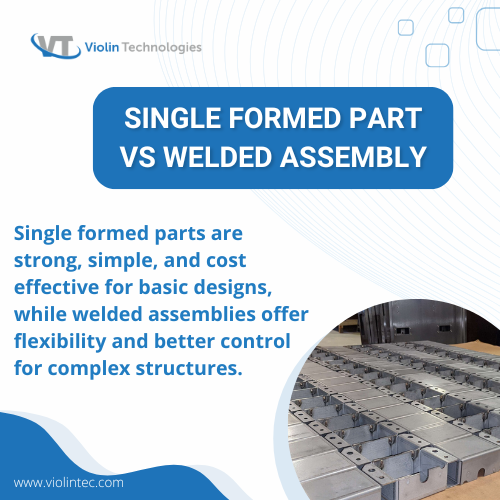
Single formed parts offer strength, simplicity, and cost efficiency for straightforward designs. Welded assemblies provide flexibility, better tolerance control for complex geometries, and scalability for larger structures.
The key is to carefully evaluate your design and work closely with experienced Sheet Metal and Stamped parts suppliers. Their expertise ensures that your product is not only manufacturable but also optimized for performance, cost, and reliability.
Making the right choice early in the design phase can save significant time, cost, and effort in the long run.