
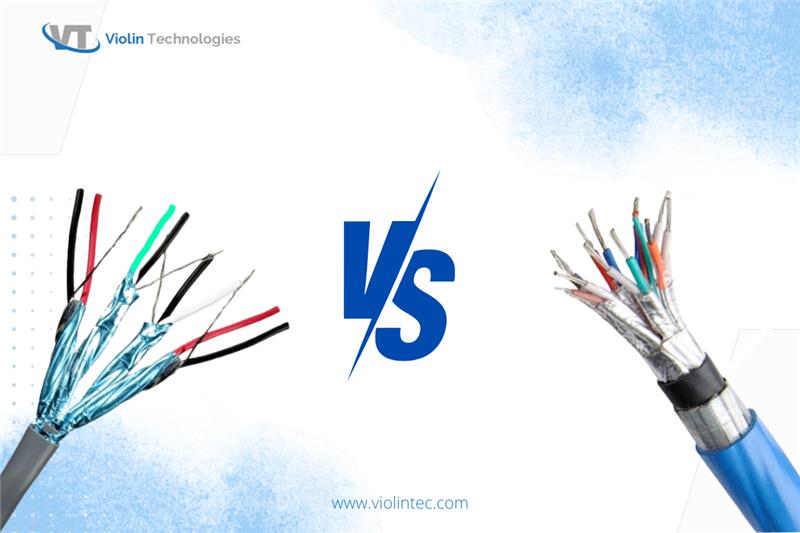
This blog breaks down control and signal cables in plain language, explains how and where each type is used, and highlights key considerations for design and procurement decisions.
What we cover in this blog?
What Are Control Cables?
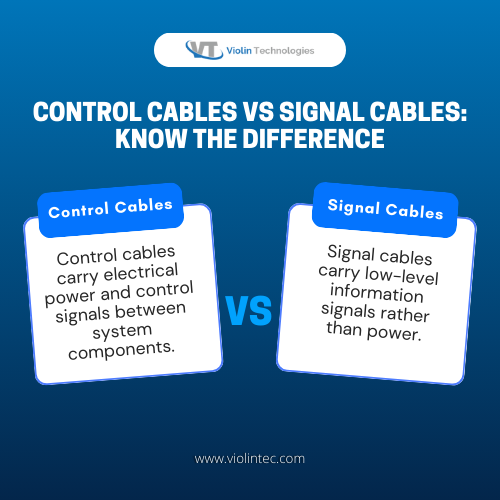
Control cables are multi-conductor cables designed to carry electrical power and control signals between system components. They are commonly used in industrial automation, machinery, HVAC systems, conveyor systems, PLC cabinets, motor starters, and similar applications where electrical energy and control commands need to be transmitted reliably.
Control cables routinely convey higher-level operational currents sufficient to activate actuators, contactors, electromagnetic relays, solenoids, and other field devices that require electrical drive.
Typical control cable functions include:
- Distributing power and control signals
- Enabling switchgear and control devices to interact
- Providing reliable electrical continuity across machines
Because of their role, control cables are designed to handle higher current loads and must withstand mechanical movement, abrasion, and environmental exposure.
What Are Signal Cables?
Signal cables, on the other hand, are designed to carry low-level electrical signals that represent information rather than power. These signals can be analog or digital and are used for instrumentation, sensor data, audio, communication protocols (such as RS-485 and Ethernet), and feedback loops in automation systems.
Signal cables are required to maintain signal fidelity by minimizing electromagnetic noise, radio frequency interference, crosstalk, and external electromagnetic disturbances that can compromise data integrity.
Signal cables are unsuitable for delivering operational current. They transmit low-level voltages or currents that encode measurement data such as temperature, pressure, positional feedback, or bidirectional communication among controllers and devices.
Key Differences Between Control and Signal Cables
Let’s look at the main areas where control cables and signal cables differ:
1. Function and Purpose
- Control Cables: Carry electrical power and control signals for the operation of equipment and devices.
- Signal Cables: Carry low-current data or information signals without powering the connected devices.
2. Voltage and Current Levels
Control cables are designed for higher voltages and currents than signal cables. In industrial settings, control cables may operate at 24 V, 120 V, or higher depending on the application. Signal cables typically operate at very low voltages (millivolts to a few volts), reflecting the sensitive nature of the information being carried.
3. Construction and Shielding
Both types of cables may have insulation and shielding, but signal cables often require more attention to shielding and pairs to avoid interference. Control cables may have thicker insulation to withstand mechanical stress and higher currents, while signal cables may use twisted pairs, foil, or braid shields to protect signal integrity.
4. Noise and Interference Immunity
Because signal cables transmit sensitive information, they are more susceptible to interference. Control cables must also resist noise, but the consequences of electrical noise on a control line are generally less severe than on a data or instrumentation line, where data integrity is critical.
5. Applications and Typical Uses
- Control Cables: Motor control, switchgear interconnections, device actuation, emergency stop circuits, contactor coils, automation panel wiring.
- Signal Cables: Sensors, transmitters, feedback devices, fieldbus communication, temperature or pressure monitoring, and data networks.
Why Choosing the Right Cable Matters
Using the wrong cable can cause failures, noisy data, malfunctions, or hazards. The key takeaway: always matches the cable to your system’s specific needs.
For example:
- Using a control cable where a signal cable is required can cause signal distortion, inaccurate sensing, or communication loss.
- Using a signal cable where a control cable is needed may result in overheating, voltage drop, or even failure of control devices.
Define your needs, understand the environment, and consult with experienced cable suppliers for the right choice.
This is where working with knowledgeable partners, such as Custom Cable Manufacturers in the USA becomes valuable. They can help match your specifications with the right cable materials and manufacturing techniques.
Design Considerations for Control and Signal Cables
Control Cable Design
Control cables generally have:
- Multiple conductors
- Copper or tinned copper for good conductivity
- PVC, LSZH (low smoke zero halogen), or other industrial insulation
- Optional armor or jacket for mechanical protection
- Grounding or drain wires where needed
Designing control cables involves calculating operational current ratings, evaluating environmental influences (such as chemical exposure, oil ingress, and temperature extremes), determining bend radius and flexibility requirements, and verifying compliance with pertinent IEC, UL, or local standards.
Signal Cable Design
Signal cables often include:
- Twisted pairs to reduce crosstalk
- Foil and/or braid shielding to reject external noise
- Small-gauge conductors for low current
- Insulation suited for low signal levels
Twisting and shielding in signal cables keeps signals clear in noisy settings.
Shielding: Why It Matters More in Signal Cables
Signal cables are more sensitive to electromagnetic interference (EMI). In facilities with heavy machinery, motors, and drives, EMI can corrupt data signals. For this reason, signal cables are often used:
- Twisted pairs: Cancels out noise picked up along the cable length
- Foil shields: Block external noise from entering the cable
- Braid shields: Provide additional mechanical strength and noise resistance
Good shielding delivers accurate, reliable data.
When to Use Control Cables Versus Signal Cables
A control cable is typically used when your system needs to send a command or power a device. Examples include:
- Sending a start/stop command from a PLC to a motor starter
- Supplying voltage to control relays
- Wiring pushbuttons and operator panels
Signal cables are used when you need precise information rather than power. Examples include:
- Transmitting temperature data from a sensor to a controller
- Sending analog or digital feedback from encoders
- Communication between field devices and control systems
Conclusion
Control cables and signal cables serve very different purposes. The key takeaway: control cables carry power and commands, while signal cables carry information. Choosing correctly is essential for performance and reliability.
Understanding these differences helps you specify, procure, and deploy the right cable types for your systems. Engaging experienced suppliers such as Contract Manufacturers in India ensures that cables and harnesses are built to spec, tested, and ready for their intended application.
Choosing the correct cable is key to reliable industrial and electrical systems.