

In this blog, we’ll explain what ANAB accreditation is, why it matters particularly for companies in contract and custom manufacturing, and how it brings global recognition to manufacturers.
What Is ANAB Accreditation?
Accreditation is a formal recognition that a certification body is competent to audit and certify organizations against specific standards, such as ISO 9001 for quality management or ISO/IEC 17025 for test labs.
ANAB, the American National Standards Institute National Accreditation Board, is one of the largest and most respected accreditation bodies in the world. Rather than certifying manufacturers directly, ANAB assesses the competence, impartiality, and performance of certification bodies that audit and certify companies.
For example:
- ANAB accredits a certification body to issue ISO 9001 certificates.
- A cable assembly manufacturing company obtains certification from an accredited body.
- The result is a certification that is credible, trusted, and accepted globally.
This two-tier system of auditor accreditation and manufacturer certification is key to building confidence in international supply chains.
Accreditation vs Certification: Why the Difference Matters
It’s important to distinguish between certification and accreditation:
- Certification confirms that an individual company meets a specific standard (for example, ISO 9001 or ISO 13485).
- Accreditation confirms that the organization doing the certification has the competence and authority to make that judgment.
In other words, certification tells you what a company meets. Accreditation tells you who gave that certification and whether their judgment is credible.
For global markets, certificates issued by accredited bodies, such as those recognized by ANAB, are far more valuable than those issued without accreditation.
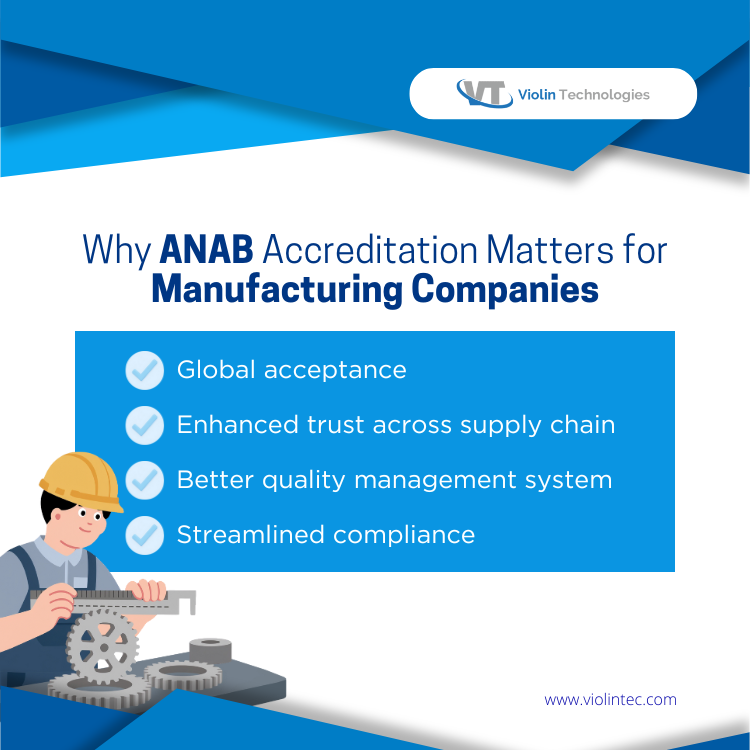
Why ANAB Accreditation Matters for Manufacturing Companies
1. Global Acceptance and Market Access
Accreditation removes barriers to global trade. When a cable assembly manufacturing company is certified by an ANAB-accredited body, that certification is more likely to be accepted by customers, regulators, and supply chain partners across borders.
For example, an OEM in Europe or North America may require suppliers to be certified by an accredited body as a condition of doing business. This is especially true for sectors such as automotive, aerospace, medical equipment, and industrial automation.
In these industries, reliability and traceability are expected, not optional.
2. Enhanced Trust Across the Supply Chain
In complex supply chains, procurement teams must evaluate multiple vendors from different regions. Technical specifications alone don’t reduce risk, but documented, accredited certification does.
For Best Contract Manufacturers in India, an accreditation-backed certificate signals to global buyers that their manufacturing systems have been evaluated against international standards. This reduces supplier qualification risk, shortens onboarding time, and improves confidence.
3. Confidence in Quality Systems and Consistency
ANAB accreditation confirms that certification bodies follow strict guidelines in conducting audits. This includes auditor competence, objective assessment processes, adequate scope and depth of evaluation, and ongoing surveillance to verify continued performance
This means when a manufacturer claims ISO 9001 certification from an ANAB-accredited body, customers can trust that the quality management system has been thoroughly evaluated.
In contrast, certifications from unaccredited bodies may not hold the same level of rigor or repeatability.
Custom Cable Manufacturers in the USA benefit when their certifications are recognized internationally. Global customers seek trusted partners whose systems are validated by respected accreditation frameworks.
4. Streamlined Compliance and Reduced Redundancy
Many multinational customers will not accept non-accredited certifications. Similarly, some regulatory frameworks reference accredited auditing as part of compliance requirements.
For companies doing business across regions, this can reduce duplication:
- No need for separate local audits
- No need to meet different interpretations of standards
- Better alignment with internationally agreed practices
ANAB’s participation in global mutual recognition arrangements (MRAs) further enhances recognition between accreditation bodies, contributing to comparability and reciprocity.
Beyond Certification: Shared Benefits Across Industries
Accreditation and the credibility it bring goes beyond the manufacturer’s credibility. Some of the broader benefits include:
Improved Operational Discipline
Accredited certification bodies apply consistent audit protocols. This encourages manufacturers to maintain disciplined internal processes, leading to more predictable outcomes.
Better Supplier Confidence
When a buyer sees an accredited certification, it becomes easier to qualify suppliers, build long-term relationships, and integrate operations.
Reduced Risk of Non-Conformance
Accreditation supports robust audit methodologies, reducing the likelihood that critical non-conformances are overlooked during certification.
Support for Continuous Improvement
ANAB-accredited certification bodies emphasize not just compliance but continual improvement; a key principle of many quality standards, such as ISO 9001.
Choosing an Accredited Certification Body
For manufacturing companies such as cable assemblies, stamped metal parts, or systems integration, selecting the right certification body is an important decision.
Criteria to consider include:
- Scope of accreditation (which standards are covered)
- Recognition by international bodies (such as ILAC, IAF)
- History and reputation in your industry
- Technical expertise and audit processes
Certificates issued by ANAB-accredited bodies carry greater weight in audits, contract reviews, and supplier assessments.
Conclusion: Accreditation Is More Than a Label
ANAB accreditation plays a vital role in building trust, credibility, and global recognition. By ensuring that certification bodies operate competently and consistently, ANAB strengthens the value of certifications across industries.
For Best Contract Manufacturers in India and other global suppliers, ANAB-accredited certifications provide assurance that quality systems meet international expectations. In an increasingly interconnected manufacturing world, ANAB accreditation is not just a technical requirement—it is a strategic advantage that supports long-term success and global partnerships.