
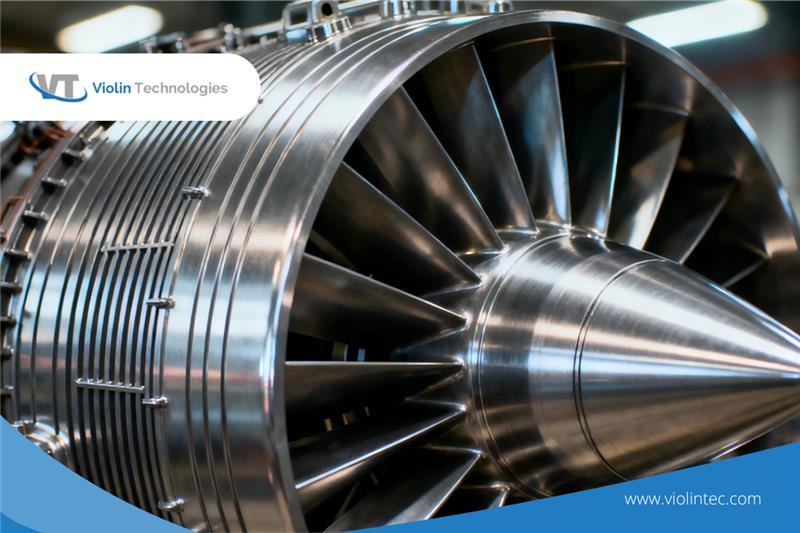
This blog explores the properties, grades, and aerospace applications of Inconel alloys, along with why working with the right Aerospace CNC machining company is critical to success.
What we cover in this blog?
- What Is Inconel
- Key Properties of Inconel Alloys
- Common Inconel Grades in Aerospace
- Key Aerospace Applications of Inconel
- Why Machining Expertise Matters
- The Role of Certified Manufacturing Facilities
- Integration With Advanced Electronics Manufacturing
- Choosing the Right Manufacturing Partner
- The Future of Inconel in Aerospace
What Is Inconel
Inconel is a family of nickel-based superalloys designed to perform in extreme environments. It is primarily composed of nickel and chromium, with additional elements such as iron, molybdenum, and niobium depending on the grade.
The defining characteristic of Inconel is its ability to retain mechanical strength at high temperatures. Unlike many metals, which weaken or oxidize at high temperatures, Inconel maintains its structural integrity even above 1000 degrees Celsius.
This makes it ideal for aerospace systems where both heat and stress are constant factors.
Key Properties of Inconel Alloys
1. High Temperature Strength
Inconel remains strong even when exposed to extreme heat. This is essential for components located near combustion chambers and turbine sections of jet engines. Materials used in these zones must resist creep deformation and structural fatigue.
2. Corrosion and Oxidation Resistance
Aircraft components often encounter high humidity, salt exposure, and combustion byproducts. Inconel forms a stable oxide layer that protects it from corrosion and scaling. This ensures longer service life and reduced maintenance.
3. Excellent Fatigue Resistance
Aerospace parts experience continuous vibration and cyclic loading. Inconel alloys resist fatigue cracking, which enhances reliability and safety.
4. High Strength to Weight Ratio
Although Inconel is denser than aluminum, its strength allows designers to reduce material thickness in certain applications. This contributes to overall weight efficiency.
5. Machining Challenges
While these properties make Inconel attractive, they also create challenges in manufacturing. The alloy works hardens quickly, generates high cutting temperatures, and rapidly wears out tools. Specialized Inconel CNC machining services overcome these hurdles when producing aerospace components.
Common Inconel Grades in Aerospace
Not all Inconel alloys offer the same properties. Manufacturers formulate different grades for specific performance requirements.
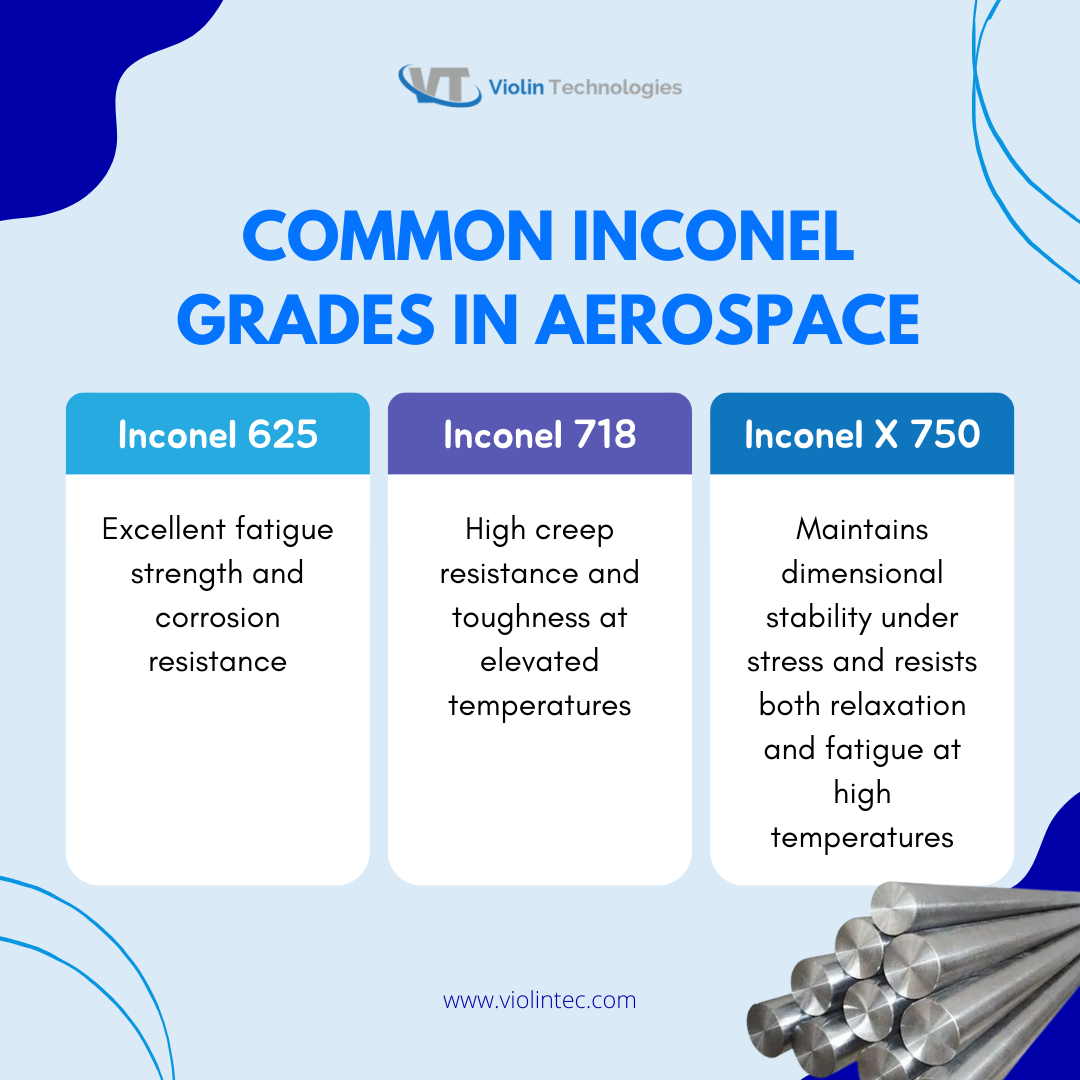
Inconel 625
Inconel 625 is widely used in aerospace due to its excellent fatigue strength and corrosion resistance. It performs well in high-pressure and high-temperature environments.
Manufacturers use Inconel 625 in exhaust systems, heat exchangers, and structural components exposed to aggressive conditions.
Inconel 718
Inconel 718 is notable for its exceptional tensile strength, high creep resistance, and toughness at elevated temperatures. Unlike 625, it can be further strengthened by heat treatment, making it suitable for applications requiring high mechanical loads and adaptability.
Engineers frequently select this grade for turbine blades, engine discs, and fasteners.
Inconel X 750
Inconel X 750 distinguishes itself by maintaining dimensional stability under stress and resisting both relaxation and fatigue at high temperatures. This makes it an ideal choice for critical fasteners, springs, and components needing constant reliability in high-heat conditions, compared to 625 and 718.
Select the right grade based on temperature range, load conditions, corrosion exposure, and design constraints.
Key Aerospace Applications of Inconel
Jet Engine Components
Jet engines generate extreme heat during operation. Engineers commonly specify Inconel for turbine blades, combustion chambers, and exhaust systems because it withstands thermal cycling and oxidation.
Gas Turbine Systems
In both aircraft and ground-based turbines, Inconel components maintain performance under continuous high temperature exposure.
Fasteners and Structural Hardware
High-strength Inconel bolts and fasteners ensure structural reliability in critical assemblies.
Rocket and Spacecraft Parts
Spacecraft require materials that withstand extreme temperatures and corrosive propellants. Inconel alloys provide durability and structural stability in these applications.
Why Machining Expertise Matters
Designing with Inconel is only half the challenge. Manufacturing precise components from this alloy requires advanced capabilities.
An experienced Aerospace CNC machining company understands the complexities of cutting superalloys. Proper tool selection, optimized cutting speeds, coolant strategies, and multi-axis machining are essential to achieve dimensional accuracy and surface finish.
Without expertise, machining defects such as tool chatter, poor surface integrity, or microcracking can compromise part performance.
The Role of Certified Manufacturing Facilities
Working with an ISO 9001-certified CNC machine shop ensures that strict quality management systems are in place. Certification demonstrates that processes are documented, monitored, and continuously improved.
In aerospace applications, traceability is critical. Manufacturers must document each batch of Inconel with material certificates, heat-treatment records, and inspection reports. A certified shop maintains these records systematically, reducing the risk for OEMs and Tier suppliers.
Quality assurance is especially important when components are integrated into high-value assemblies produced by a best electronics contract manufacturer or system integrator. A single faulty part can disrupt an entire supply chain.
Integration With Advanced Electronics Manufacturing
Modern aircraft combine mechanical systems with advanced electronics. Engineers frequently design Inconel structural components to house or support sensitive electronic assemblies.
Collaboration between the best electronics contract manufacturer and a precision machining partner ensures that mechanical and electronic systems integrate seamlessly. Tight tolerances, thermal management considerations, and vibration resistance must be aligned across both domains.
This integrated approach enhances performance and reduces rework during final assembly.
Choosing the Right Manufacturing Partner
Consider the following when choosing a supplier for Inconel aerospace components:
- Proven experience with Inconel CNC machining services
- Multi-axis machining capabilities
- In-house quality inspection and testing
- Material traceability systems
- ISO 9001 certification
- Aerospace industry references
A capable Aerospace CNC machining company produces quality parts and provides design feedback to improve manufacturability and cost efficiency.
The Future of Inconel in Aerospace
As aircraft engines become more fuel-efficient and operate at higher temperatures, the demand for high-performance superalloys continues to grow. Inconel remains at the forefront due to its balance of strength, durability, and corrosion resistance.
Additive manufacturing also expands the possibilities for complex Inconel geometries. Even with new technologies, machinists must use precision machining to finish critical surfaces and achieve tight tolerances.
Conclusion
Inconel alloys are vital in aerospace for their ability to withstand extreme conditions while maintaining strength and integrity. These performance benefits require manufacturing expertise, precision CNC machining, and strict quality control.
Partnering with an experienced Aerospace CNC machining company and an ISO 9001 certified CNC machine shop ensures that every component meets the highest performance and safety standards. When combined with collaboration from the best electronics contract manufacturer, aerospace systems can achieve the reliability and precision that modern aviation demands.