

That’s why a seemingly invisible property inside the metal — known as residual stress — can make or break an aerospace build. And when manufacturers start with materials engineered to have Minimum Residual Stress (MRS), it can mean the difference between a precision, reliable component and one that’s unpredictable.
Let’s take a deep dive into what MRS really means, why it’s critical for aerospace components, and how choosing the right supplier is vital for both structural integrity and bottom-line efficiency.
What we cover in this blog?
What is Residual Stress and What Makes MRS Special?
Residual stress refers to internal stresses locked inside a material even after all external forces are gone — stress that remains “hidden,” but very real.
These stresses may arise from prior manufacturing steps, such as rolling, extrusion, heat treatment, forming, and even welding or surface operations.
Now, in many aerospace parts, think of fuselage skins, structural frames, wing stringers; a lot of material is machined away from a base plate or extrusion. If that base material contains uneven internal stress, machining can unbalance the internal stress field, causing the part to bend, warp, or “potato-chip.” This can throw off critical dimensions or even render the part unusable.
That’s where Minimum Residual Stress (MRS) materials come in. The MRS plate or sheet is processed to minimize or “relax” internal stresses before machining begins. This gives far more predictable behavior when material is removed.
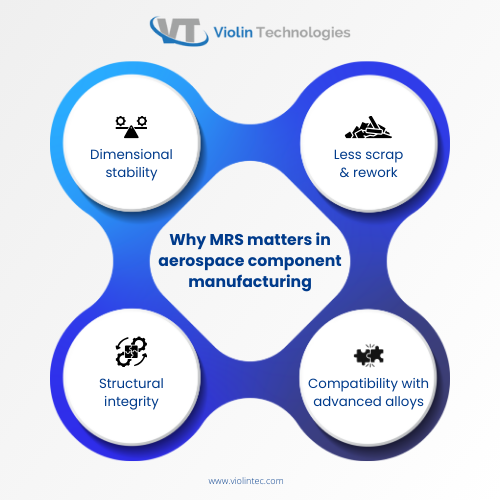
Why MRS is a Game-Changer for Aerospace Components
Here’s what adopting MRS does for aerospace production:
1. Dimensional Stability & Machining Accuracy
MRS materials stay flat and stable even after deep pocketing or aggressive machining, which is essential when parts must meet tight tolerances.
For any aerospace CNC machining company, reducing post-machining distortion improves repeatability; meaning parts from different batches behave consistently. That’s critical for large-scale builds or components that will later be assembled.
2. Higher Yields, Less Scrap & Rework
Without MRS, unexpected warping or distortion can force scrapping of costly aluminum or titanium parts — not to mention added labor and machine downtime.
With MRS, the risk of scrapping decreases, production yield increases, and manufacturing becomes more predictable. For suppliers labeled among the top-quality contract manufacturing partners, this reliability can improve delivery schedules and reduce overall costs.
3. Structural Integrity & Safety
Aviation and aerospace parts must withstand harsh environments, cyclic loads, pressurization, vibration, and fatigue — all without failing. Residual stress, added to these loads, can dangerously accelerate fatigue, crack initiation, or even stress-corrosion cracking.
Starting with MRS-certified materials ensure that what’s hidden inside the base metal does not compromise long-term performance or safety.
4. Compatibility with Advanced Alloys & Complex Designs
Modern aerospace design often uses high-strength alloys, complex geometries, thin skins, deep machining pockets — designs that demand stable base stock. MRS processing is already available in aerospace-grade alloys, allowing fabricators to push design and weight savings without risking distortion.
How MRS Materials Are Produced and Verified
MRS isn’t a magic term — it’s earned through controlled processes.
Common techniques include:
- Tension leveling / Stretching — applying controlled tension across the plate to relieve internal stress
- Thermal stress relief — carefully heating & cooling cycles to let internal strains relax.
- Balanced rolling and quenching techniques — managing mechanical and thermal processing to avoid uneven stress build-ups.
After processing, materials are often tested using stress measurement techniques (e.g., x-ray diffraction, hole-drilling, or other lab methods) to ensure internal stress gradients are within acceptable thresholds.
Only then can the plate or sheet carry the MRS label; a guarantee of internal stability before machining even begins.
Impact on Aerospace Manufacturing Supply Chains
Choosing MRS-feedstock influences more than just one part. It improves the entire manufacturing pipeline.
- Consistent batch-to-batch performance — when material performance is predictable, manufacturing plans become reliable.
- Faster turnaround times — less rework or scrap means quicker delivery.
- Reduced inspection overhead — fewer surprises after machining means QA becomes smoother and less resource-intensive.
- Better alignment with OEM expectations — aerospace OEMs expect parts to meet tight specs; MRS helps meet them reliably.
For companies looking to work with the Best Quality Contract Manufacturing Partners in the USA, MRS usage is often a differentiator — showing commitment to quality, precision, and reliability from the base material itself.
How to Choose the Right Manufacturing Partner: What to Ask and What to Expect
If you’re sourcing aerospace components or evaluating suppliers, these are key questions to ensure you get the benefit of MRS:
- Do you use MRS-certified aluminum or titanium plate/sheet for structural parts?
- Can you provide documentation of residual stress measurement / stress-relief process?
- Is your manufacturing partner experienced in aerospace CNC machining, especially for deeply machined or thin-walled components?
- Do they offer consistent batch-to-batch traceability and quality control?
If the answer is yes, you’re more likely to receive components that meet tight tolerances, deliver on schedule, and perform reliably over their service life.
Final Thoughts
In aerospace manufacturing, precision isn’t just a buzzword; it’s a necessity. When entire aircraft safety, structural integrity, aerodynamic performance, and long-term durability depend on micron-level tolerances and perfectly flat surfaces, what lies beneath the surface of your raw material matters a lot.
Minimum Residual Stress (MRS) isn’t just a nice-to-have. For most critical aerospace components, it’s a must-have. It lets design engineers push boundaries, helps machinists deliver predictable parts, and ensures final assemblies meet stringent safety and performance standards.
If you’re working with an aerospace CNC machining company or seeking a reliable manufacturing partner, contact our team today to explore MRS-grade materials and precision machining. It’s not just about getting parts; it’s about building trust, safety, and performance of flight after flight.